Showing posts with label Religion. Show all posts
Friday, 4 July 2014
Brajesh's Review : DK Eyewitness - Religion
We are big fans of DK Eyewitness books and collect them as souvenirs of our travels. Apart from great pictures and useful information, the books never leave you overwhelmed with information. For DK books, less is more and the pictures do most of the talking.
I browsed through this book at a book-shop and the beautiful pictures with summary narrative, got me interested. Over 70 pages, the book gives a summary insight into all the major religions of the world. It covers Egyptian, Greek and Primal ways of life. Then moves onto Hinduism, Buddhism, Jainism, Confucian Piety, Tao Principles. Shinto Harmony, Sikh Teachings and Zoroastrianism.
Then the three Abrahamic religions of Judaism, Christianity and Islam precede the final section on new religious beliefs of Scientology, Hare Krishna, Mormons & Unification Family Church. Each of the major religions are given 6 beautiful spreads and others are given 2 pages. I would recommend this to be a part of your collection, as a good reference book for quick fact-checks and photo reference on Religion. @ 199/- it’s a DK steal.
Rating : 3 / 5
Saturday, 16 November 2013
Brajesh's Review : Cain
I quote from the book "The history of mankind is the history of our misunderstandings with god, for he doesn't understand us, and we don't understand him." And that on page 73 was the essence of this hilariously lighthearted yet potently sharp critique of the Biblical God.
My wife who had a better understanding & knowledge of Biblical Religious literature, tells me that the Old Testament God is mostly an angry one. That is exactly what troubles Jose Saramago in this book, and he manifests the unforgiving, selfish and egoistic God through the story of a time traveling Cain.
Everything about the book is brilliant, the translation in my mind actually added another layer, though one can't say that with certainty without reading the Portuguese original.
The story covers a wide set of episodes from the killing of Abel, destruction of Sodom & Gomorrah, destruction of Tower of Babel, Abraham's sacrifice of Isaac, Job's agony, Lot's rescue, Noah's ark, Moses's golden calf and in each of the cases the author systematically and logically with agonising pain exposes the flawed God.
P.S. I doubt literature like this could ever be produced India, given our total lack of ability to debate any politically and religiously controversial point of view with any sense of openness or tolerance. And that makes me sad.
Rating : 4.5 / 5
Labels:
4+,
Book Review,
Christianity,
Fiction,
Religion,
Translation
Friday, 11 October 2013
Brajesh's Review : Raj Yoga Mediation & Children's Father - Prajapita Brahma
I bought these when we visited the Brahmakumari's HQ ashram in Mount Abu.
I wanted to know the History behind the Brahmakumaris movement - hence the Amar Chitra Katha like book and the Philosophy - hence the Raj Yoga Booklet.
In both cases the thought is nice, simple and idealistic. But the books are written so badly (language/grammar / sentence construction) that you are more likely to dismiss an interesting philosophy than be engaged further.
If you want to delve into the sect and it's philosophy I would recommend watching Astha Channel's discourses rather than read any of the official publications in English.
Rating : 2 / 5
Friday, 26 July 2013
Brajesh's Review : 99 Thoughts on Ganesha
Another simple, yet powerful Devdutt Pattanaik book. The line drawings are beautiful and could have formed a book on their own, the narrative is pure bonus and what a bonus it is. As usual the mythological insights in the book are profound and intuitive at the same time, that remains Devdutt's signature in all his attempts.
Being a collector of Ganesha idols, the book evoked strong affection and feelings for me. I am a Devdutt Pattanaik fan and believe that he is a modern day Valmiki - a master story teller, hence the book gets an additional 0.5.
Rating : 4 / 5
Friday, 30 November 2012
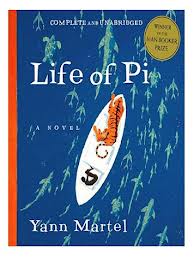
Brajesh's Review: Life of Pi
Yann Martel's - "Life of Pi" has been on my bookshelf for over 2 years. But I finally decided to read it, just before watching the movie - since we firmly believe that over 90% of the time, the books are better than their movies.
When I was done reading, I felt quite bad about not reading "Life of Pi" earlier. Truly a masterclass.
The simplicity of words and the power of the message is so beautifully woven in an impossible situational story line. The movie makes a brilliant attempt in taking the core of the book and turning it into a spectacle which in my guess will take a minimum of 4 Oscars this year.
I recommend to every person who has seen the movie to read this book and submerge oneself in the beautiful discourse on religion and food :) Those were the two parts which connected with me best. Since food is nothing but God's grace on earth ;) ;)
Rating: 4.5 / 5
Labels:
4+,
Book Review,
Fiction,
Food,
Philosophy,
Religion,
Slice of Life
Saturday, 15 September 2012
Kim's Review: God's Little Soldier
I've been a huge fan of Kiran Nagarkar, ever since I first met him in Bombay in 2006 and read Ravan and Eddie almost immediately after. My favourite book by him is most definitely Cuckold, which I bought and read as soon as we moved back to India.
The biggest problem with Nagarkar's books are the size and hence the subsequent weight which makes them difficult to carry around or read in bed. So I was waiting for God's Little Soldier to come out in paperback before I got around to reading it and it was a very long wait. I expect, I am going to have an equally long wait for the paperback version of The Extras (the sequel to Ravan and Eddie) too, unless I finally succumb and pick up an e-reader version.
What I really love about his books are that they tell stories from the protagonists point of view and even though you may not agree with the protagonist, you can empathise with him to quite an extent. There is also a gritty style of writing in Kiran's work that is reminiscent of pulp fiction at times, but for me it just makes his characters more real, more "human" so to speak.
When we met Nagarkar at JLF earlier this year, he wanted to know if I liked his latest book and I confessed that I was waiting for it to come out in paperback. Self-deprecating as always, he said "don't buy my books, they aren't worth reading. I just write for the sake of writing, call it an old mans indulgence" Anyone who has met Nagarkar would know that this is definitely not sarcasm, its just how he sees himself.
Yet he puts in so much time and effort into each one of his books and I think God's Little Soldier must have been the most difficult one to research so far. It spans countries, religions and dogmas and needed physical as much as literary research.
Kiran goes back to a familiar theme of his, as seen in Ravan and Eddie: "How do 2 boys brought up in somewhat similar circumstances react differently in similar situations?"
In Ravan and Eddie, the boys are brought up in the same chawl but in different religions. In God's Little Soldier, Zia and Amanat are sons of the same parents, but Amant being sickly from birth gets more care from his mother, while Zia is a favourite with his aunt Zubeida.
Their parents are liberal muslims, but Zubeidakhala is more traditional in her views and beliefs. How these childhood influences creep up into their behaviour later in life is interesting to watch as the story unfolds.
When Kiran wrote this book, he said it was because he wanted to show that not all "terrorists" come out of Madrasas. It is possible to have a top notch education and liberal upbringing but circumstances could still propel you into a hardline view.
The book is divided into 3 distinct parts. The first has Zia and Amanat growing up in Bombay. While they come from a fairly well to do family, they lose everything when their fathers partner (who is also their mothers brother) disappears with all the money and leaves their father with a couple of court cases hanging over his head.
Amanats frail constitution keeps him at home most of the time, while Zia goes away, first to boarding school and then to London to study. Zia is brilliant at Mathematics and numbers speak to him but his real calling is Economics and the world of financial trading. However Zia's religion is also equally important to him and a failed attempt to assassinate Salman Rushdie takes him to Afghansitan and Kashmir where he becomes a dreaded terrorist.
In the second part, constant visions of a reproachful Christ and the revalation that an aunt (friend of his parents) baptised him in a church as an infant lead him towards Christiantiy and he becomes the monk Lucens. His new crusade is against abortionists.
In the 3rd part, his plan to "correct" the world is even more grandiose and he gets even more dogmatic in his beliefs. He now comes under the influence of Shakta muni who also practices tantra and initiatesZia/Lucens into it and while outwardly he is still Brother Lucens, he also carries a diplomatic passport in the name of Niranjan.
This is the briefest summary of this 610 page novel that I can give you.
Conflict and struggle on a global scale and in the characters hearts and minds. Zia's constant belief in himself as the man who has all the answers is extremely egoistical, but he never sees it in that perspective. He is more critical of everyone and extremely unforgiving.
Amanat on the other hand veers towards self pity without actually going there. He has talents as a teller of tales and in architecture but denies them both to his own detriment.
In a way, both brothers seem intent to follow a path of self destruction.
This is a book that will leave you with as many questions as answers. At 610 pages, the size is massive but the tale will keep you engrossed. The book is well researched and a lovely piece of fiction. If you have the time, then you should definitely give it a try.
Rating: 4/5
Labels:
4+,
Book Review,
Christianity,
Exile,
Fiction,
India,
Indian Author,
Politics,
Religion,
Relocation,
Slice of Life,
Society
Thursday, 13 September 2012
Kim's Review: The Walled City
Esther David's The Walled City tells the tale of a young Bene Israeli Jewish girl born in 1940 in Ahmedabad in the first person. This girl is surrounded by a myriad influences, customs, cultures and stories and the book tells the tale of her trying to make sense of it all.
Her paternal grandmother has adopted some Marathi customs (including the way she wears her sari)and even though she is illiterate, she knows all the Hebrew prayers and has her own strong beliefs.
Her mother Naomi's relationships with everyone in the family are strained and as a working woman, she is an abberration at her husbands house. But she has very strict views on what is the "right" way that a Jewish girl should be raised and detests any "non Jewish" influences in her daughters life.
Compared to her mothers strong influence, her father doesn't have as much of an influence/ impact on her life and he does come across as hen pecked.
Her maternal grandfather Daniel who worked with a British firm has adopted a lot of their habits and customs.
Her foreign returned doctor aunt who dresses smartly but has her own demons to face.
Her cousins Malka & Samuel who are just a little older than her and just as confused.
All of these people have a different Jewsih perspective and influence on this young girls life.
She studies in a Christian convent school.
She is exposed to the Hindu way of life through her childhood friends Subhadra and Pratibha, who share tales from their own beliefs, teach her Indian dance and she sometimes joins them in their prayers saying she feels more comfortable praying in a temple than in a synagogue.
.
Living in the Walled city, they have a lot of Muslim neighbours and her uncle invites them to use their large backyard for celebrating festivals and functions where the cousins are exposed to biryanis and singing girls.
.
Ancestral photos show women of previous generations wrapped in the 9 yard sari dhothi/Marathi style with nose rings, armlets & anklets adorning them, but her mother Naomi has a huge fight with her father Daniel, when he buys anklets for his granddaughter to wear, saying that Jewish girls should wear no ornaments except a chain, brooch, watch or bangles.
The messages she receives about her own religion are mixed. Her uncle Menachem winks when he says that it is not permissible to mix milk & meat while happily rounding off a non vegetarian meal with pedhas or gulab jamuns. She doesn't know Hebrew and hence does not know what any of her prayers mean which she finds in strong contrast to her Hindu friends who know exactly what they are saying when they pray.
The difference in food, in expectations, in beliefs and traditions all keep assaulting this young girl but she has nowhere to get answers to the questions that plague her.. The casteist feelings between Baghdadi jews and Bene Israeli Jews brings about its own set of worries for this girl.
How does she deal with it all, how do all these people impact her life, what is the purpose of her life, will she be able to assert any kind of independence. All these questions constantly come up in the mind of the reader of this book.
Each of the characters is well etched and its very easy to sympathise with most of their perspectives since the author explains where each one of them is coming from.
Esther David changed professions (from an art critic) & wrote this novel when she was almost 50. She says she wrote this book to understand herself, her community and her religion. She confesses to not doing any research but just writing straight from her heart.
And it worked. The Walled City's largest success has been in the world of Global Jewish Literature and while there are a lot of nuances of Jewish life in Ahmedabad revealed in the tale, the tale itself could be of any young girl born into any small community in any Indian non-metro city.
The Walls of the city referenced in the book are symbolic of the walls of Indian communities, of the family and of being a woman. In Esther David's words, The Walled City is all about isolation and immense cross cultural conflict.
A lovely read, the book is not so much about the walled city of Ahmedabad but about the search for ones identity.
Does this book give a perspective on Ahmedabad the city it is set in?
Not so much, it could be set in any walled city.
Does this book give a perspective on growing up Jewish in Ahmedabad/India?
Most definitely, yes!
Rating: 4 / 5
Labels:
4+,
Behaviour,
Book Review,
Exile,
Fiction,
Gujarat,
India,
Indian Author,
Religion,
Relocation,
Slice of Life,
Society,
Women Centric
Thursday, 31 May 2012
Kim's Review: Habibi
At over 670 pages, Habibi took Craig Thomson over 6 years to illustrate and write.
This was one of the most difficult books I've read recently. The problem is that the story is so compelling that it drews me in and I wanted to keep moving forward, but the illustrations were so beautiful they were pulling me back to keep taking a closer look at them and get drawn into their intimate details and intricacy.
The story is set in a fictional land with juxtaposition of the monotheistic religions Islam, Judaism and Christianity. There is the modern and the ancient - Sultans guards wearing sunglasses and driving trucks as well as camels. The costumes travel the world with the protagonist Dodola wearing harem pants, saris, Spanish skirts, the Hijab at times and sometimes a burqa. Hijras(as they exist in India) also have a significant role to play with their Bahuchari Mata.
But at the essence of it, the story line seeks to elucidate how we create differences amongst ourselves based on religion, financial muscle, caste, creed, colour, land of origin. Its also about the struggle for resources and in this way can also be construed as an "end of days" tale.
There are so many layers, so many meanings and lessons that one can learn from this or one can just sit back and admire the beautiful calligraphy and art work.
I can't say enough about this book and what I write, can never be enough. So I've just added a few of the pictures of pages from this book that I found in the public domain. (via google image search)
Rating : 5 / 5
I keep going back and opening the book on a random page just to enjoy the art
Labels:
5 on 5,
Award Winning,
Behaviour,
Book Review,
Christianity,
Exile,
Fantasy,
Fiction,
Graphic Novel,
Mythology,
Politics,
Religion,
Relocation,
Revolution,
Slice of Life,
Society,
Speculative Fiction,
Women Centric
Thursday, 15 December 2011
Brajesh's Review: The Rozabal Line
If you are interested in history, religion and/or historical fiction and haven't yet read Ashwin Sanghi, your life is incomplete. I don't say this lightly but the amount of religious history and new insights you will be exposed in this one book is more than enough for a lifetime of research. Still wondering how he did it
Rating: 4.5/5 - half a point deducted for having just too much info in a book. More than any normal human mind can handle. What a writer!
Subscribe to:
Posts (Atom)