Wednesday, 21 November 2012

Brajesh's Review: Tutankhamun - The Last Secret


I loved Christian Jacq's Ramses series so much, that I was quite excited when I got my hands on this book. I guess my big expectations from the book is what let me down.

However on a stand-alone basis, this is an interesting approach to tell the story of Egypt's freedom movement. The backdrop of the story has characters like Nasser, King Faroque, Suez Canal, CIA and Egyptian Intelligence services. The other story is around the myth of John Howard and Tutankhamun's legend. The myths, magic and mystery kept me engaged, but the end really let me down :( .

As I said, this book probably let me down on expectations and so did the ending. I still remain a big fan of Christian Jacq and I'm sure I will delve into his books at regular intervals given my interest in Egyptian History & Mythology

Rating: 3 / 5


Tuesday, 20 November 2012

Brajesh's Review: Kitnay Aadmi Thay?


This is a landmark book for me. This is the first time I have got an acknowledgement by the author and I can tell you, I felt awesome when I accidentally discovered the same.

Dipto is a dear friend, & I was eagerly looking forward to this book, after his previous one on Cricket - I pre-ordered the same :-). I must say the joy of discovering your name in print is an unmatched feeling, and in my case this has inspired me to do a book of my own :) Diptakirti Chaudhuri, I will hopefully reciprocate this acknowledgement one day.

Thank You Diptakirti Chaudhuri :) You are a gentleman and a friend I will treasure always.

Now back to the book content, being written by a friend I obviously have not rated the book, but any self-confessed bollywood fan MUST own this one. The book is constructed like a mosaic of trivia and that adds to the discovery and journey. What makes this book unique is it does not get caught in the clichéd lists and I must say the books gets better post intermission.

The second half has more commentary, the authors point of views on lists which are very hilarious and these make second half better.

Not Rated

Kim's Review: The Second Empress - A Novel of Napoleons Court


The Second Empress is Michelle Moran's latest offerring. Her second in the Europe series after Madame Tussaud and her 5th novel, 3 of which Nefertiti, The Heretic Queen and Cleopatra's Daughter are set in Egypt. Having read 4 out of her 5 books, I can definitely say that her books set in Europe are more realistic than her historical fictions set in Egypt and are eminently more pleasurable to read.

Personally, with my exposure to Egypt and its history, I feel Michelle tries to impose a European sensibility even in her Egyptian novels and that doesn't sit right for me, but may work well for her European readers.

Her next 2 books are set in India and the next novel is based on Rani Laxmibai of Jhansi.

I found the Second Empress as pleasurable as Madame Tussaud. The book is well researched and well written.

I have just a passing knowledge of European History and I just knew the bare bones about Napoleon except for his raiding of Egypt. The facts I knew about him, could be summed up as
1. short stature
2. conquered large parts of Europe and North Africa
3. loved his wife Josephine
4. was exiled to Elba (this because of the palindrome "able was I, I saw Elba")

Before I read this book, I did not even know that he had married a second time, after divorcing Josephine (who had a son & daughter from a previous marriage).

The Second Empress centers around Maria Lucia - Archduchess of Austria who is forced to marry Napoleon and transform herself into the French Empress Marie Louise to save Austria from being re-attacked by France after the already humiliating Treaty of Schonbrunn.

Napoleon was much older than her, he was hated in Austria for the humiliation he heaped on her father the Duke and the Austrian people, his first wife Josephine was loved by the French masses who considered her to be Napoleons good luck charm, his divorce from Josephine was not recognised by the church, her aunt Marie Antoinette had been beheaded just a few years before by the French public, she was already in love with Count Adam Neipperg, she was being groomed to be regent when her father died as her brother sufferred from some kind of mental illness and she had been brought up to hate France. Inspite of all this, Marie Louise finds herself forced into marriage with Napoleon.

The other voice in this book is that of Pauline Bonaparte - Napoleons sister. As ambitious as him, if not more so. By the time the book starts Pauline has already buried one husband, taken numerous lovers and is married again to an Italian noble. She however only dreams of ruling Egypt as her brothers wife.

The final voice in the tale is that of Paul Moreau, Pauline's Haitian chamberlain who is in love with her. He provides a commoners/slaves point of view to the tale.

Napoleons family is as headstrong as him and constantly give him grief from their behaviour. Jospehine's daughter is forced to attend to Marie Louise and Pauline constantly tries to convince her brother to return to Egypt to rule with her.

The book covers Napoleons days of glory, his defeat and exile to Elba, his second bid for power and Marie Louise's subsequent independence from him.

The history in itself is fascinating and Michelle has woven an even more riveting tale through the facts with emotions and a humanising of the historical characters. While it is slightly in the Historical chicklit genre, there is a lot of history and facts that are revealed through the tale. Most women would enjoy this book, but I'm not so sure if men would. Honestly, Madame Tussaud is the only one of Michelles books that I would recommed to my husband, knowing the kind of books he prefers to read, but I'd unhesitatingly recommend The Second Empress to all my female friends.

Rating : 3.5 / 5


Monday, 19 November 2012

Brajesh's Review: Moth Smoke


Mohsin Hamid has written one of the darkest books I have read in a very long time. The book uses the protagonist’s journey into darkness as a backdrop to bring nuances of characters and society into spotlight.

As usual the construction and body of the book is a joy in itself, but the way this books reaches out to the dark spots and leaves you with the gut wrenching familiarity of pain is classic. When you start relating to the darkness in a plot, it is a very uncomfortable feeling and I went through the same almost through the entire read.

Just a small example : the way he uses "Pajero" as a symbol of evil money-power in Pakistan, left a Pajero owner like me cringing. . . . While his Reluctant Fundamentalist has got more publicity, this is a classic one should not miss.

Rating : 4 / 5


Tuesday, 2 October 2012

Kim's Review: The Shadow Throne


When I first read the blurb about this book on Blogadda, I thought the premise seemed interesting and it would be worth taking a look at a thriller set in the current Indian scenario, written by an Indian author. Humphrey Hawksley had used a large Indian setting in The Third World War and other authors have written tales set in various parts of India,  but this is the first thriller I read, set in the present Indian national political scenario.

Honestly, the book took me by surprise. It arrived on Friday and I carried it with me on our weekend road trip. We completed an extremely hot and dusty exhausting journey into the Little Rann of Kutch on Saturday and had more in store for Sunday. After a refreshing bath, I was just planning to skim a few pages before I dropped off to sleep and the next thing I knew, I was half way through the book. I had to force myself to shut the book and turn off the lights, so I could get at least a couple of hours sleep. We returned on Sunday after a full day of sightseeing in the heat. It was another quick bath and then everything else (including dinner) was put on hold until I finished the book. And THAT is how gripping this book is!

The book opens with Chandra, an investigative journalist who has recently lost his wife to cancer being called to a murder scene at the Qutub Minar by Inspector Syed Ali Hassan. The dead mans skull is flat on the back and its not the fall that has caused it. Then begins a high octane whirlwind chase across India, Pakistan and their respective multiple investigative agencies.

With the help of his wife's friend history professor Meenakshi Pirzada, they figure out that the dead man is actually a Kushan - a race thought to have been extinct centuries ago. And the chase heads towards the Hindu Kush mountains and Bamiyan in Afghanistan.

Do the Kushans still survive? Who is on which side? Who is playing whom? How is China involved? How large is this conspiracy? Who is the puppet master? What is the Shadow Throne? Who has claims to this throne? The questions come fast and furious and the action moves as quickly as an episode of "24".

The story ends on a note which makes me belive that it will spawn a series of sequels and Chandra, Hassan and Meenu will star in all of them. If Aroon Raman can maintain the pace and tell us as engaging tales as he has in this one, I will definitely be buying them all.

Aroon Raman has researched his subject extensively and briefly explains technicalities that the reader may not be conversant with. In this way he differs from my other favourite Indian thriller - Ashwin Sanghi's  The Rozabal Line - where I was constantly googling for more information as I was reading, which was a bit distracting. This makes The Shadow Throne, easy to finish in a single sitting, given how taut the story line is.

My only dissonance with this book is that I couldn't get my head around how effective Aroon Raman's fictionalised version of RAW and Indian Military Intelligence is. The actions and decisions are more FBI and CIA like in efficiency, than Indian.

A brilliant well paced book, definitely a must-read for anyone who enjoys thrillers, India-Pakistan relations and politics.

Rating: 4.5 / 5


Also read Brajesh's Review of the Shadow Throne

This review is a part of the Book Reviews Program at BlogAdda.com. Participate now to get free books!

Wednesday, 26 September 2012

Kim's Review: I Spy A Slenderman and Other Dark Tales


In the interests of full disclosure, Deepti was one of my first online editors (at desicritics), and though the website has been retired, our relationship steadily grew into a friendship over a shared love of travel, cats and books.

While I have been content writing the occasional blogpost and a couple of articles, Dee has gone on to publish FOUR ebooks - 2 novellas and 2 books of short stories. I Spy A Slenderman and Other Dark Tales is her 4th ebook.

The 7 short stories in I Spy A Slenderman, all revolve around  things that go bump in the night: vampires, succubuses, mischievous Greek Gods and werewolves.

While all the tales have slightly unexpected endings, Tryst with a God definitely goes in directions that I would never have predicted and I Spy a Slenderman has a mounting build up of suspense.

The book is an easy read and since its a book of shorts, its ideal for reading on your digital device while sipping a coffee, waiting for a flight, or whenever you have a few minutes free. If you like the genre that is not really Hitchcockian horror, but the Vampire Diaries/True Blood/Buffy version of horror, then you will love these stories.

I promise you won't be disappointed.

Rating : Dee is a friend & in the interests of friendship, we don't rate books written by friends :)

Update on 1st July 2013:
I Spy a Slenderman is now available in hard copy on Amazon and it also has my first review printed in the book being reviewed :)


Saturday, 15 September 2012

Kim's Review: God's Little Soldier


I've been a huge fan of Kiran Nagarkar, ever since I first met him in Bombay in 2006 and read Ravan and Eddie almost immediately after. My favourite book by him is most definitely Cuckold, which I bought and read as soon as we moved back to India.

The biggest problem with Nagarkar's books are the size and hence the subsequent weight which makes them difficult to carry around or read in bed. So I was waiting for God's Little Soldier to come out in paperback before I got around to reading it and it was a very long wait. I expect, I am going to have an equally long wait for the paperback version of The Extras (the sequel to Ravan and Eddie) too, unless I finally succumb and pick up an e-reader version.

What I really love about his books are that they tell stories from the protagonists point of view and even though you may not agree with the protagonist, you can empathise with him to quite an extent. There is also a gritty style of writing in Kiran's work that is reminiscent of pulp fiction at times, but for me it just makes his characters more real, more "human" so to speak.

When we met Nagarkar at JLF earlier this year, he wanted to know if I liked his latest book and I confessed that I was waiting for it to come out in paperback. Self-deprecating as always, he said "don't buy my books, they aren't worth reading. I just write for the sake of writing, call it an old mans indulgence" Anyone who has met Nagarkar would know that this is definitely not sarcasm, its just how he sees himself.

Yet he puts in so much time and effort into each one of his books and I think God's Little Soldier must have been the most difficult one to research so far. It spans countries, religions and dogmas and needed physical as much as literary research.

Kiran goes back to a familiar theme of his, as seen in Ravan and Eddie: "How do 2 boys brought up in somewhat similar circumstances react differently in similar situations?"

In Ravan and Eddie, the boys are brought up in the same chawl but in different religions. In God's Little Soldier, Zia and Amanat are sons of the same parents, but Amant being sickly from birth gets more care from his mother, while Zia is a favourite with his aunt Zubeida.

Their parents are liberal muslims, but Zubeidakhala is more traditional in her views and beliefs. How these childhood influences creep up into their behaviour later in life is interesting to watch as the story unfolds.

When Kiran wrote this book, he said it was because he wanted to show that not all "terrorists" come out of Madrasas. It is possible to have a top notch education and liberal upbringing but circumstances could still propel you into a hardline view.

The book is divided into 3 distinct parts. The first has Zia and Amanat growing up in Bombay. While they come from a fairly well to do family, they lose everything when their fathers partner (who is also their mothers brother) disappears with all the money and leaves their father with a couple of court cases hanging over his head.

Amanats frail constitution keeps him at home most of the time, while Zia goes away, first to boarding school and then to London to study. Zia is brilliant at Mathematics and numbers speak to him but his real calling is Economics and the world of financial trading. However Zia's religion is also equally important to him and a failed attempt to assassinate Salman Rushdie takes him to Afghansitan and Kashmir where he becomes a dreaded terrorist.

In the second part, constant visions of a reproachful Christ and the revalation that an aunt (friend of his parents) baptised him in a church as an infant lead him towards Christiantiy and he becomes the monk Lucens. His new crusade is against abortionists.

In the 3rd part, his plan to "correct" the world is even more grandiose and he gets even more dogmatic in his beliefs. He now comes under the influence of Shakta muni who also practices tantra and initiatesZia/Lucens into it and while outwardly he is still Brother Lucens, he also carries a diplomatic passport in the name of Niranjan.

This is the briefest summary of this 610 page novel that I can give you.

Conflict and struggle on a global scale and in the characters hearts and minds. Zia's constant belief in himself as the man who has all the answers is extremely egoistical, but he never sees it in that perspective. He is more critical of everyone and extremely unforgiving.

Amanat on the other hand veers towards self pity without actually going there. He has talents as a teller of tales and in architecture but denies them both to his own detriment.

In a way, both brothers seem intent to follow a path of self destruction.

This is a book that will leave you with as many questions as answers. At 610 pages, the size is massive but the tale will keep you engrossed. The book is well researched and a lovely piece of fiction. If you have the time, then you should definitely give it a try.

Rating: 4/5


Thursday, 13 September 2012

Kim's Review: The Walled City


Esther David's The Walled City tells the tale of a young Bene Israeli Jewish girl born in 1940 in Ahmedabad in the first person. This girl is surrounded by a myriad influences, customs, cultures and stories and the book tells the tale of her trying to make sense of it all.


Her paternal grandmother has adopted some Marathi customs (including the way she wears her sari)and even though she is illiterate, she knows all the Hebrew prayers and has her own strong beliefs.

Her mother Naomi's relationships with everyone in the family are strained and as a working woman, she is an abberration at her husbands house. But she has very strict views on what is the "right" way that a Jewish girl should be raised and detests any "non Jewish" influences in her daughters life.

Compared to her mothers strong influence, her father doesn't have as much of an influence/ impact on her life and he does come across as hen pecked.


Her maternal grandfather Daniel who worked with a British firm has adopted a lot of their habits and customs.

Her foreign returned doctor aunt who dresses smartly but has her own demons to face.

Her cousins Malka & Samuel who are just a little older than her and just as confused.

All of these people have a different Jewsih perspective and influence on this young girls life.

She studies in a Christian convent school. 

She is exposed to the Hindu way of life through her childhood friends Subhadra and Pratibha, who share tales from their own beliefs, teach her Indian dance and she sometimes joins them in their prayers saying she feels more comfortable praying in a temple than in a synagogue.
.
Living in the Walled city, they have a lot of Muslim neighbours and her uncle invites them to use their large backyard for celebrating festivals and functions where the cousins are exposed to biryanis and singing girls.
.
Ancestral photos show women of previous generations wrapped in the 9 yard sari dhothi/Marathi style with nose rings, armlets & anklets adorning them, but her mother Naomi has a huge fight with her father Daniel, when he buys anklets for his granddaughter to wear, saying that Jewish girls should wear no ornaments except a chain, brooch, watch or bangles.

The messages she receives about her own religion are mixed. Her uncle Menachem winks when he says that it is not permissible to mix milk & meat while happily rounding off a non vegetarian meal with pedhas or gulab jamuns. She doesn't know Hebrew and hence does not know what any of her prayers mean which she finds in strong contrast to her Hindu friends who know exactly what they are saying when they pray.

The difference in food, in expectations, in beliefs and traditions all keep assaulting this young girl but she has nowhere to get answers to the questions that plague her.. The casteist feelings between Baghdadi jews and Bene Israeli Jews brings about its own set of worries for this girl.

How does she deal with it all, how do all these people impact her life, what is the purpose of her life, will she be able to assert any kind of independence. All these questions constantly come up in the mind of the reader of this book.

Each of the characters is well etched and its very easy to sympathise with most of their perspectives since the author explains where each one of them is coming from.

Esther David changed professions (from an art critic) & wrote this novel when she was almost 50. She says she wrote this book to understand herself, her community and her religion. She confesses to not doing any research but just writing straight from her heart.

And it worked. The Walled City's largest success has been in the world of Global Jewish Literature and while there are a lot of nuances of Jewish life in Ahmedabad revealed in the tale, the tale itself could be of any young girl born into any small community in any Indian non-metro city.

The Walls of the city referenced in the book are symbolic of the walls of Indian communities, of the family and of being a woman. In Esther David's words, The Walled City is all about isolation and immense cross cultural conflict.

A lovely read, the book is not so much about the walled city of Ahmedabad but about the search for ones identity.

Does this book give a perspective on Ahmedabad the city it is set in?
Not so much, it could be set in any walled city.
Does this book give a perspective on growing up Jewish in Ahmedabad/India?
Most definitely, yes!

Rating: 4 / 5


Tuesday, 28 August 2012

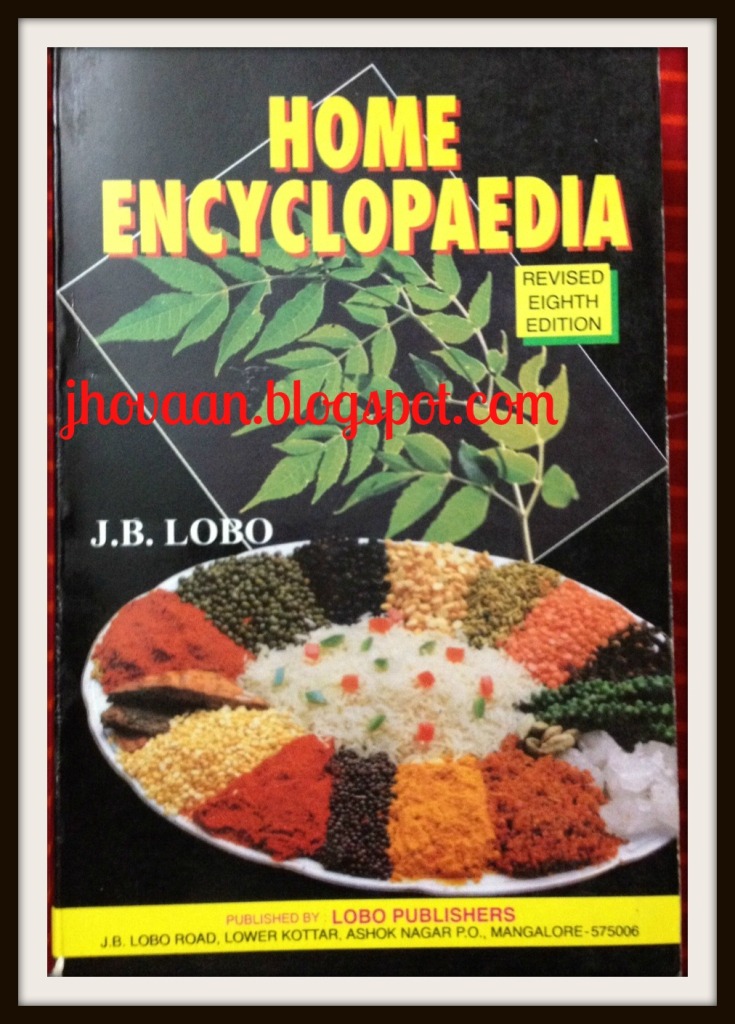
Kim's Review: JB Lobo's Home Encyclopaedia

JB Lobo's Home Encyclopedia is the only recipe book my grandmother ever referred to when cooking, so almost every woman in my family has a copy.

The book is plain text, there are no glossy pictures and an average of 3-4 recipes on each page. A bare bones recipe book, it expects the reader to have a good grasp of cooking.

It does have some rare recipes like that for suckling pig Manglorean style that are difficult to find elsewhere. While it claims to have recipes from other parts of the world, remember that this book was written over 25 years ago, so those recipes aren't completely authentic. But the Manglorean recipes are really good.

More than half the book is taken by the home encyclopedia which has home remedies for everything from sore eyes to snake bites and scorpion stings. There is a section on how to guard against burglars, how to clean ivory articles and how to buy a cow by checking her udders. There is even a section on sex education.

While the book at 900+ pages is quite heavy, only 250 pages or so are dedicated to recipes. I do wish they would come out with a version that has just the recipes. It would be so much easier to manage while trying to cook from it.

The book is also published in Kannada as Gruha Sangaathi & I think it has both a vegetarian and a non-vegetarian version.

Rating : 4 / 5


Monday, 30 July 2012

Kim's Review : GameWorld Trilogy - Simoqin Prophecies, Manticore's Secret, Unwaba Revelations


Samit Basu wrote Simoqin Prophecies when he was just 22 and published it when he was 23. Manticore's Secret and Unwaba Revelations followed 3 & 5 years later. He also writes comics.

I first heard of Basu at this years's JLF. It prompted me to buy the first of the trilogy. However with our move following almost immediately after our return from Jaipur, I wasn't getting time for much reading. Since I was heading on a road trip to Rajkot, I carried the Simoqin Prophecies with me and by the time I finished the first few chapters, I pushed in my dongle, logged onto flipkart and ordered the next 2 books in the series and they were waiting for me at home by the time I returned 3 days later.

I read all 3 books at a stretch over 4-5 days (since I still have plumbers, electricians and painters doing the rounds of the apartment, if I didn't have these botherations, I wouldn't have looked up until I finished all 3)

The good thing about each book is that, the end of the book does bring some amount of closure and does not leave the reader on tenterhooks. This would have been a really good thing for those who read the books when they first came out and had to wait for a year or so between books.

Samit Basu seems to have taken Shakespeare's "All the world is a stage and all the men & women merely players" completely to heart with this trilogy. All the characters live on a "game world" and are being played around with by the Gods.

The inspirations and spoofs come fast and strong. Nothing is spared, from the Ramayan and Mahabharath to King Kong, Alice in Wonderland to Arabian Nights. Inspirations come from world history, Greek & Indian mythology, fairy tales, Harry Potter, superhero comics, dragon tales and pop culture amongst others.

Be prepared to meet a host of different species from crow air forces, to stork couriers, to Vaanar senas. Vamans who live below the earth (for the most part) to pashans who hatch from eggs but are made of various kinds of stones. Magical, mythical creatures. Some unfamiliar and some familiar like asurs and rakshasas, but are they really as "bad" as they are made out to be?

The Simoqin Prophecies start 200 years after the death of the rakshas Danh-Gem and the departure of the ravians from this world. The Prophecy foretells the return of Danh-Gem 200 years after his death and the arrival of a hero who will slay him. The details of how the hero will arrive are also mentioned in the prophecy and powerful people get involved in engineering a hero to fit the prophecy. Are heroes really heroes or are their tales of heroism just airbrushed stories? Who is a true hero? Can heroes be created in a school meant for heroes?

The ending was quite a surprise, I was expecting something else entirely.

I started book 2 - Manticore's Secret almost immediately. In this book a lot more insight is given into the Gods who are playing this "game world". So do the God's control our destinies? Or do we even have a destiny other than to be a pawn in a God's game? What is right & what is wrong? Who is right and who is wrong? Each person / species thinks in a particular way for a particular reason. Do noble intentions justify ignoble actions?

Part 3 - Unwaba Revelations - does have some surprises, but I personally was quite happy with the ending. It was neat enough for me and did not leave me with a huge number of unanswered questions.

I don't want to give away too much of the story in this review, because these are really books you SHOULD read for yourself.

For me, the GameWorld Trilogy has been as mind bogglingly wonderful as the Lord of the Rings with loads of humour too. These books are what the teens on my gift list in the near future shall be receiving for awhile.

Rating : 4.5 / 5


Related Posts Plugin for WordPress, Blogger...